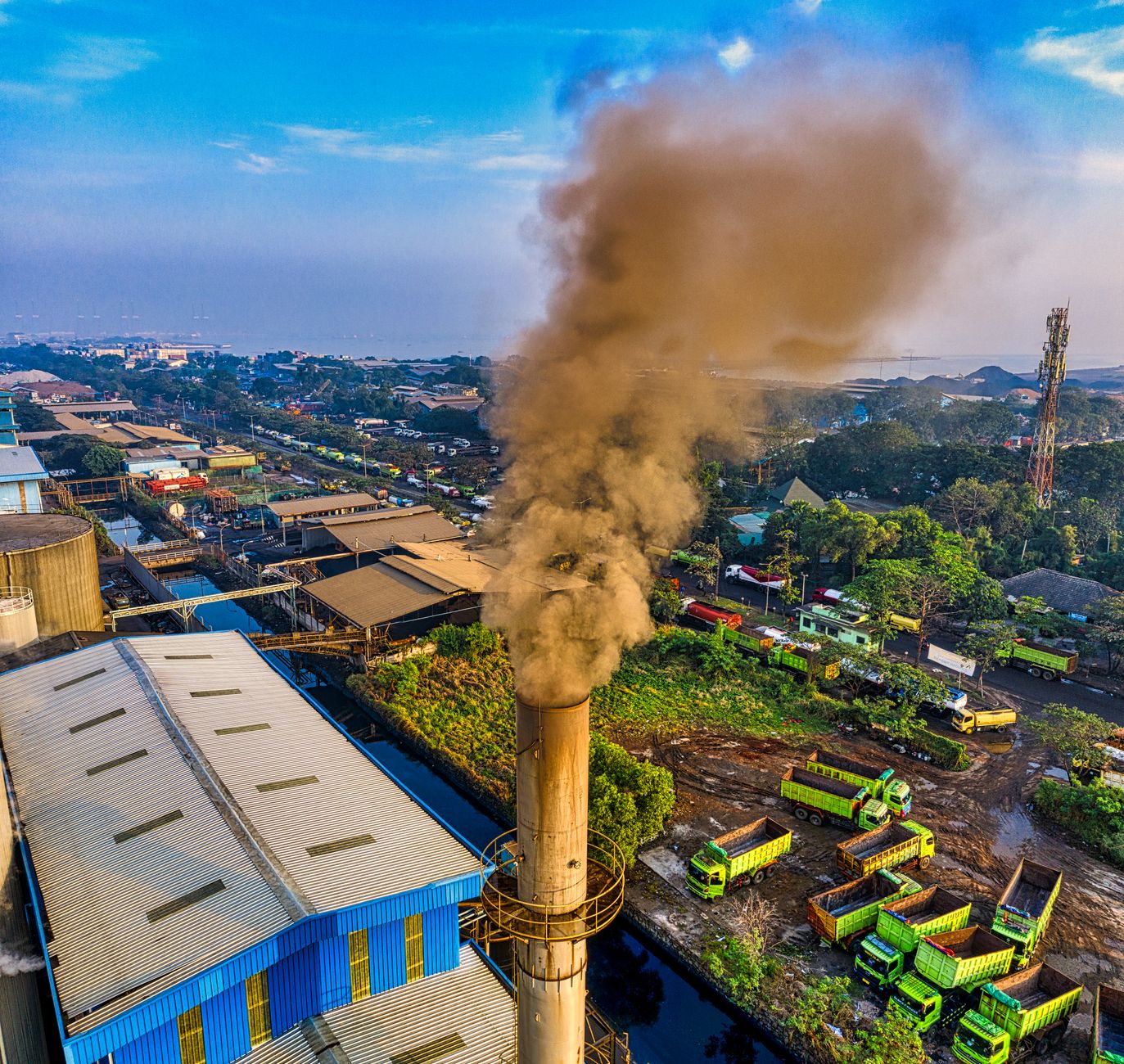
Detroit has handed five industrial companies roughly $46 million in pollution-related tax exemptions over the past decade, and the city got nothing in return. No additional cleanup commitments. No enhanced air quality monitoring. No say in whether the exemptions were even appropriate. The money flowed out under a state law that most Detroiters have never heard of, toward facilities that have long defined the air quality crisis in Southwest Detroit.
Three of those five companies are owned by Marathon Petroleum, the Houston-based refining giant that operates one of the largest oil refineries in the Midwest on Detroit’s southwest side. The other two are unnamed in publicly available summaries, but all five collectively received 28 exemptions under Michigan’s Air Pollution Control Act over a ten-year period. The law allows companies to apply for temporary exemptions from state air pollution standards, typically when equipment breaks down or when a facility is upgrading pollution controls. In practice, critics argue, it functions as a recurring subsidy for the same heavy emitters, year after year.
That $46 million figure is not an estimate or a projection. It represents actual exemptions granted, meaning actual accountability that was waived, actual penalties that were never assessed, and actual tax revenue that never reached Detroit’s general fund.
What the Law Actually Does
Michigan’s Air Pollution Control Act includes a provision allowing the state Department of Environment, Great Lakes, and Energy, known as EGLE, to grant facilities relief from pollution control requirements under specific circumstances. The state legislature designed the exemption mechanism as a safety valve, a way to give companies time to fix problems without immediately shutting down operations that employ workers and power local economies.
That logic has limits. When the same facilities receive multiple exemptions across multiple years, the mechanism stops looking like a safety valve and starts looking like a structural workaround. Twenty-eight exemptions over ten years across five companies works out to nearly three exemptions per year on average. Marathon Petroleum’s Detroit-area operations account for the bulk of that number.
The exemptions carry financial value because they allow companies to avoid the costs associated with compliance. Those costs include upgrading pollution control equipment, paying fines for excess emissions, and potentially curtailing operations. When a company receives an exemption, the state essentially absorbs the enforcement gap. The economic benefit to the company is real, and the law’s structure means those benefits are quantifiable, hence the $46 million figure attached to Detroit’s exemption history.
Marathon Petroleum’s Footprint in Southwest Detroit
Marathon’s Detroit refinery sits along the Detroit River in the 48217 zip code, a neighborhood that residents and environmental advocates have called the most polluted zip code in Michigan for years. The refinery processes crude oil and produces gasoline, diesel, and other petroleum products. It operates around the clock and releases a range of pollutants including sulfur dioxide, nitrogen oxides, benzene, and particulate matter.
The facility is not the only heavy emitter in the area. Southwest Detroit hosts a concentration of industrial operations, truck routes, and diesel facilities that combine to create what public health researchers describe as cumulative pollution burden. Children in neighborhoods like Boynton, Springwells Village, and Oakwood Heights experience higher rates of asthma hospitalizations than Detroit averages, which are themselves elevated compared to state and national figures.
Marathon has long maintained that its Detroit operations comply with applicable regulations and that the company invests in community relations and environmental upgrades. But compliance with regulations that have been temporarily waived through exemptions is not the same as compliance with the underlying pollution standards. The exemptions, by definition, mean the standards were not met. The question is how often, for how long, and what communities absorbed in the meantime.
What $46 Million Means for Detroit’s Budget
Detroit’s financial situation gives the $46 million figure additional weight. The city emerged from the largest municipal bankruptcy in U.S. history in 2014 and has spent the years since rebuilding public services, pension obligations, and basic infrastructure. The city’s annual budget runs roughly $2.7 billion, and departments that serve Southwest Detroit neighborhoods, including the health department, parks and recreation, and neighborhood services, have all faced pressure to do more with less.
Forty-six million dollars does not flow directly out of Detroit’s general fund when a pollution exemption is granted. The mechanics are more diffuse. When companies avoid compliance costs through state-level exemptions, they avoid the capital expenditures and fines that would otherwise circulate through the local economy or, in the case of penalties, reach state environmental funds that support monitoring and enforcement. The indirect cost to Detroit is harder to calculate but no less real.
There is also the public health cost. Each time emissions standards are waived, residents near those facilities breathe air that does not meet the standards Michigan’s own law established as protective. Emergency room visits, lost school days, reduced worker productivity, and chronic disease management all carry price tags, and those costs land disproportionately on families in Southwest Detroit who cannot afford to move away from the pollution sources anchoring their neighborhoods.
Who Holds Oversight, and Who Does Not
EGLE administers the exemption process at the state level. Local governments, including Detroit, have no formal role in approving or challenging exemptions. City council members cannot vote to deny an exemption. The mayor’s office cannot impose additional conditions. Detroit’s health department has no seat at the table when EGLE reviews an application.
This structure puts all meaningful authority in Lansing, far from the neighborhoods where the consequences are felt. It also means that state legislators, not Detroit officials, control the policy levers that could change how exemptions work.
Several state lawmakers representing Southwest Detroit districts have raised concerns about cumulative pollution burdens in recent sessions, but Michigan has not passed legislation that would require community notification before exemptions are granted, mandate health impact assessments, or cap the number of times a single facility can receive relief in a given period. Bills that would add those guardrails have not advanced to floor votes.
Detroit City Council has passed resolutions in recent years calling for stronger state and federal oversight of industrial facilities in Southwest Detroit, but resolutions carry no enforcement power. They document concern without compelling action.
Mayor Mike Duggan’s administration, and now the mayor-elect’s office as the city manages a transition into 2026, has engaged with Marathon and other industrial operators on community agreements and fence-line monitoring programs. Those agreements exist outside the formal exemption process, however. A company can accept a community agreement and still apply for, and receive, pollution exemptions through the state.
The Political Question Nobody Is Answering Directly
The accountability gap is specific. Michigan law permits an industrial facility to temporarily exceed pollution standards, assigns the state sole authority to grant that permission, quantifies the financial benefit of that permission in the tens of millions of dollars for Detroit alone, and asks nothing of the communities that absorb the health consequences of the arrangement.
State legislators who represent districts in Southeast Michigan sit on committees that oversee EGLE and could advance reforms to the exemption process. They have not done so at a scale that matches the documented harm. The reasons vary by legislator. Some have pointed to competing legislative priorities, the complexity of environmental regulation, and the influence of industrial employers in their districts.
Environmental justice advocates who have tracked the exemption issue for years argue that the political inertia reflects something more fundamental. The residents of 48217 and surrounding neighborhoods are disproportionately Black and low-income. The companies receiving exemptions are among the largest and most politically connected corporations operating in Michigan. That imbalance does not cause lawmakers to ignore the issue entirely, but it shapes how urgently the issue is treated relative to other demands on legislative attention.
What Reform Could Look Like
Advocates and some policy researchers have proposed several specific changes that would alter the power dynamics around pollution exemptions in Michigan.
One approach would require EGLE to notify affected municipalities before granting an exemption, giving city health departments and council members a formal opportunity to submit comments or request hearings. That would not give Detroit veto power, but it would create a public record of local concerns and put state officials on notice that someone is watching.
A second approach would cap the number of exemptions a single facility can receive within a rolling five-year period, forcing companies with chronic compliance problems to make capital investments rather than cycling through repeated waivers.
A third approach would direct a portion of penalties collected from facilities that exceed their waiver limits into a community health fund administered at the local level, giving cities like Detroit a direct financial stake in enforcement outcomes.
None of these reforms has advanced to a committee vote in the current legislative session.
The Bottom Line for Detroit
Five companies. Twenty-eight exemptions. Forty-six million dollars. A decade of quietly waived accountability, concentrated in a city already carrying a disproportionate share of industrial pollution and its public health consequences.
Detroit did not design this system. Detroit cannot unilaterally change it. But Detroit’s residents, advocates, and elected officials can force a clearer public accounting of what the system costs, who benefits, and why the political will to reform it has not materialized.
The money that flows through pollution exemptions is not abstract. It is quantifiable, it is documented, and it has been flowing in one direction for a long time.