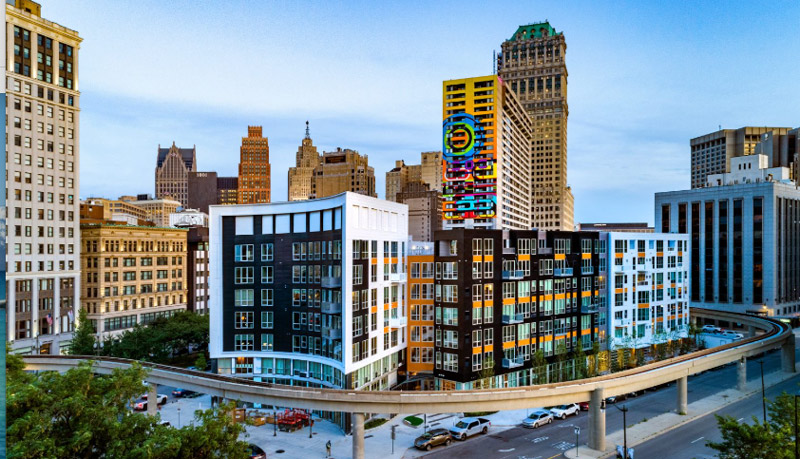
A new study puts a number on something developers and city planners have been arguing about for years: how many people actually want to live in Greater Downtown Detroit. The answer, according to the Downtown Detroit Partnership, is enough to absorb 17,055 housing units every year.
That figure comes from the Downtown Detroit Residential Market Potential Study, released this spring by the Downtown Detroit Partnership and produced by Zimmerman/Volk Associates in partnership with the Downtown Business Improvement Zone. The study covers nine neighborhoods: Corktown, Rivertown, Lafayette Park, Eastern Market, Midtown, Woodbridge, TechTown, New Center, and downtown proper. It’s the first update since 2017, which means the data is finally catching up to nearly a decade of change on the ground.
The headline number breaks down this way. Downtown alone shows potential for 9,250 households annually, with capacity for between 1,047 and 1,373 new units per year. Expand the lens to Greater Downtown and that annual absorption range jumps to 1,987 to 2,563 units. Those aren’t fantasy projections built on wishful thinking. They represent real, quantified demand across income levels, household types, and age groups.
Who’s driving the numbers? Younger people, mostly. Nearly 64 percent of the identified market is younger singles and couples, which tracks with what you see walking around Midtown on a Friday or cutting through Brush Park toward Woodward. But the study also flags empty nesters and retirees as a significant slice of demand, and that’s the part that should get developers thinking harder about unit mix and price points.
Demand isn’t coming only from people already inside 8 Mile Road. Nearly half of all potential households originate from outside Detroit and Wayne County, and more than 21 percent come from outside the metro region entirely. People are watching Detroit from Chicago, from New York, from places that cost three times as much to rent a one-bedroom. That’s real pull.
Rental demand sits at 72.2 percent of total households, which tells you something important about where the affordability pressure actually lives. It’s not just a preference. It reflects the gap between what people earn and what for-sale housing costs right now, even in a market that’s still cheap by coastal standards.
Eric B. Larson, CEO of the Downtown Detroit Partnership, put the practical target plainly. “Currently, there are more than 6,500 residents, and with the potential identified in the study, we are targeting an increase of 4,000 residents in downtown Detroit over the next five years, bringing the total to 10,000 residents,” Larson said. He also acknowledged that getting there won’t happen on its own: “Realizing this opportunity will require continued collaboration to address policy and economic barriers to support residential growth.”
That word “barriers” is doing a lot of work in that sentence. Detroit has no shortage of sites. What it has a shortage of is financing structures that make ground-up residential pencil out, especially for affordable units in a market where construction costs have climbed steadily since 2021. The 2026 Residential Potential Study quantifies demand, but demand alone doesn’t build anything.
Worthy of attention.
The study covers neighborhoods that are at wildly different stages of development. Lafayette Park already has a stable residential base going back decades. Corktown has seen significant private investment since Ford Motor Company took over the Michigan Central Station site. Eastern Market draws foot traffic but has lagged on residential conversion. TechTown and New Center have real vacancy to fill. Treating all nine areas as one market would be a mistake, and serious developers will read the neighborhood-level data before committing to a site.
For residents already in these neighborhoods, the study lands as both validation and a warning. Validation because the demand signals confirm that Greater Downtown has real magnetism, not just event-driven foot traffic. The warning is that 17,000 units of annual potential demand, if it actually materializes, will push rents in ways that affect people living in those neighborhoods right now. The Downtown Detroit Partnership and city planners at the Detroit Housing Commission will need to be specific about how affordability gets built into whatever growth follows, not treated as an afterthought once the market-rate projects are fully leased.
Gina Cavaliere, chief community impact officer and Downtown Detroit BIZ executive director, told reporters that “Detroit is a city that welcomes everyone and invites people to find their place here.” Getting from 6,500 downtown residents to 10,000 will require more than a welcoming posture. It will require zoning flexibility, subsidy tools, and developers willing to build housing that serves the 72 percent of potential residents who need affordable rental options, not just the fraction who can afford a luxury tower overlooking the river.