Shavonne Coleman’s professional directing debut didn’t arrive quietly. It arrived with one of the most demanding plays in contemporary American theatre, a cast navigating sexual violence and survival, and a run at the Detroit Repertory Theatre that closed May 17.
Coleman is a Detroit-based actress and assistant professor at the University of Michigan. She’s spent years writing, performing, and coaching youth productions across Michigan. But “Eclipsed” was the first fully professional stage production she’d ever helmed, and she didn’t ease into the role with something small.
The play itself carries real historical weight. “Eclipsed” was written by Danai Gurira, the actress and playwright known for her roles in “Black Panther” and “The Walking Dead.” Gurira premiered it at the Woolly Mammoth Theatre Company in Washington, D.C., in 2009. It didn’t reach Broadway until 2016, when Lupita Nyong’o joined the cast and the production broke through to a wider audience. Detroit’s own run at the Rep brought that story to a city that doesn’t always get top-shelf regional work in that mold.
The script is set in Liberia in 2003, the closing months of the Second Liberian Civil War. That conflict started in 1999 when Liberians United for Reconciliation and Democracy launched a military offensive against President Charles Taylor. It finally ended in 2003. But the country had barely recovered from the First Liberian Civil War, which had run from 1989 to 1997, killing thousands and pulling child soldiers into armed factions throughout the fighting. Two wars in roughly a decade. That’s the ground Gurira’s play stands on. You can find the scope of that documented history through the Liberia section of the United Nations Peacebuilding Commission’s documentation.
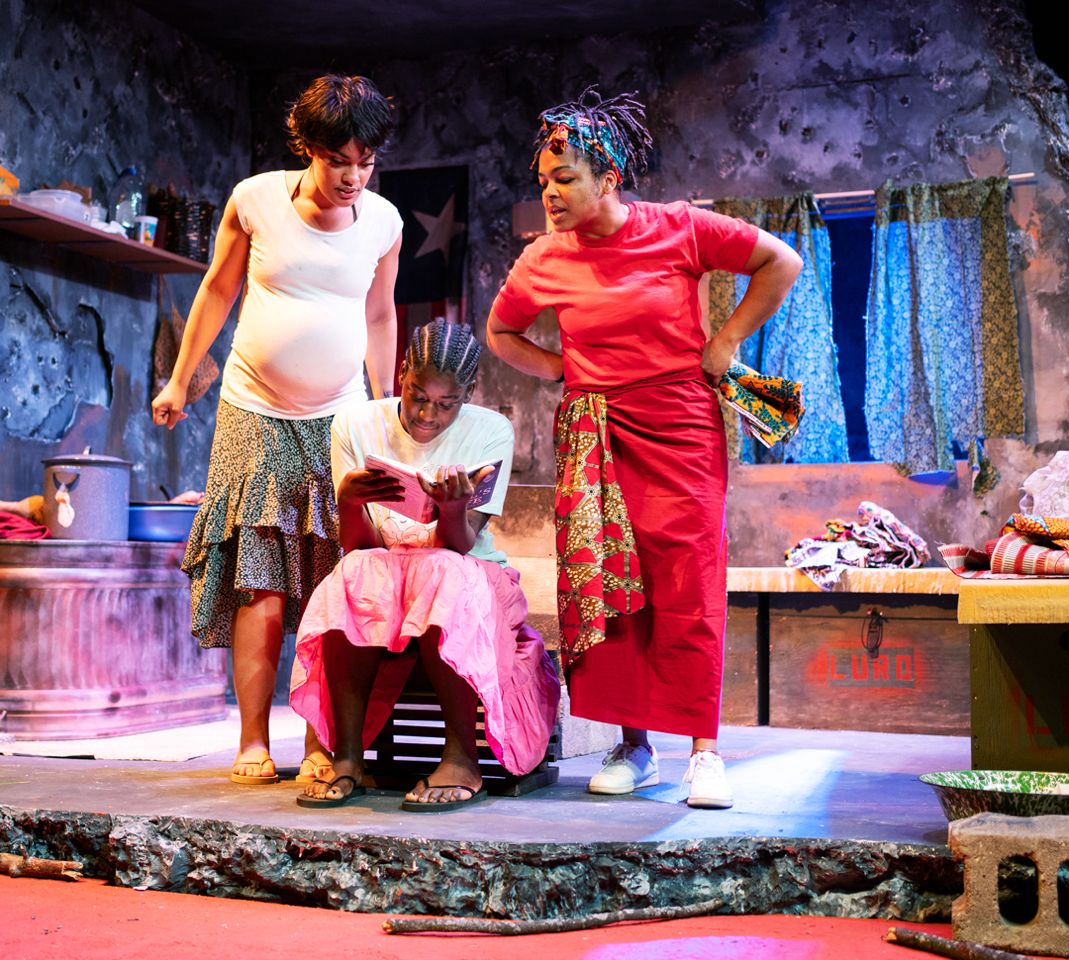
What Gurira does with that backdrop is refuse to let the war consume the characters. Five women carry the story. Helena and Bessie, referred to as wives number one and three, have been kidnapped and sexually assaulted by a commanding officer. They’re keeping watch over a teenager, identified only as “The Girl,” who the officer has now targeted. The three women survive together in a shack while the war rages outside. It doesn’t define them. Their bond does.
Coleman told BridgeDetroit she didn’t walk into this project knowing much about the Second Liberian Civil War. She read. She watched documentaries. One detail from that research stayed with her long after the prep work was done: Liberians in those documentaries kept saying they believed America was coming to save them. That kind of specific, painful detail is the difference between a production that performs relevance and one that earns it.
“While reading it, I had this moment of being like, ‘Yes, this is a story that needs to be told,’” Coleman said.
That’s not a casual read of a script. That’s someone who found a personal entry point into material that could easily stay at arm’s length. The pressure was real. So was the clarity.
“There were times where I felt pressure and then there were times where I felt like I was exactly in the room I was supposed to be, doing what I was supposed to be doing,” Coleman said.
Coleman’s background in Detroit’s arts world runs deep. She works with Mosaic Youth Theatre of Detroit, adapting scripts and coaching young performers. Her role at the University of Michigan puts her in front of theatre and drama students regularly. That combination of mentorship and academic work shapes how she runs a rehearsal room. She’s not coming to professional directing as a first language. She’s been building toward it through years of work with performers at every stage of development.
The Detroit Repertory Theatre, sitting at 13103 Woodrow Wilson, has been staging work since 1957. That’s nearly seven decades of productions in a building that hasn’t chased trends or relocated to a trendier ZIP code. Coleman’s debut in that space isn’t just a personal milestone. It’s a story about what Detroit’s arts infrastructure makes possible when it stays put and keeps the door open.
“Eclipsed” ran through May 17.