The Fisher Building’s 26th floor has been empty for years, but it holds more history than most occupied offices in Detroit.
Jacob Jones has been leading tours of the Fisher Building for more than a decade, working with Pure Detroit and the Albert Kahn Legacy Foundation. He knows every lunette, every fresco, every strange corner of the building Albert Kahn designed for the Fisher brothers back when this stretch of West Grand Boulevard was the center of the automotive world. On a recent private tour, he brought a small group up to floor 26, which sits above the public elevator stops and below the old executive suites on 27 and 28. Most people who visit the Fisher Building every day have no idea the floor exists.
“It’s rare today, I think, to have a building that combines beauty, combines engineering, and is also a place that is open and presented to the public on a daily basis,” Jones said.
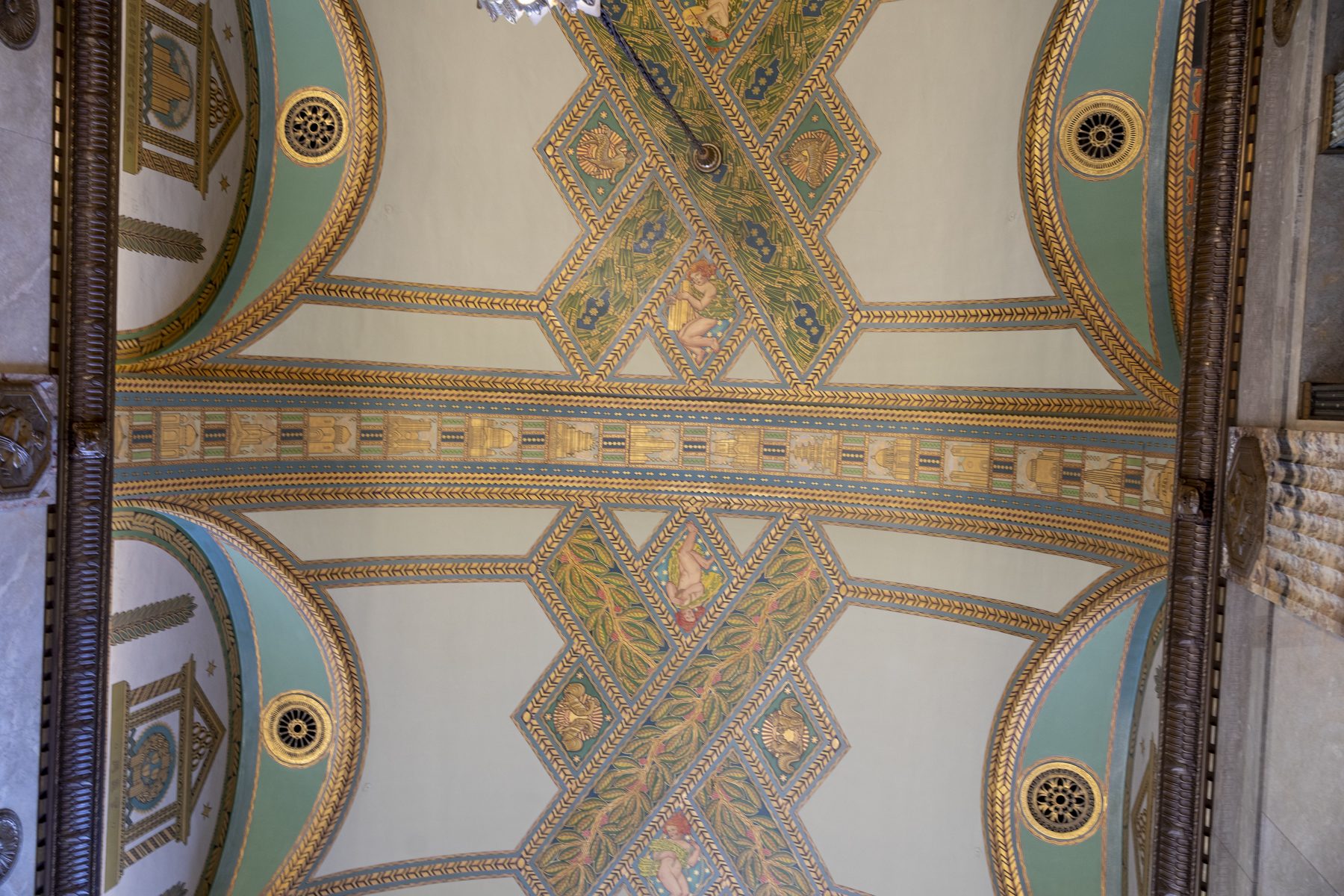
He means that sincerely. The Fisher Building isn’t a museum behind glass. It’s a working building on Second Avenue in the New Center neighborhood, and its arcade is open. You can walk in on a Tuesday afternoon and look up at frescoes painted by roughly 200 crew members under the direction of Hungarian artist Géza Maróti. You can count the 26 bronze-colored medallions set into the lunettes along the arcade ceiling. Most people hurrying through don’t.
Those medallions weren’t decorative choices made for beauty alone. They were the building’s original ventilation system, disguised. The architects hid the air vents inside ornate wheels so the mechanical infrastructure of the building would disappear into the art. That’s the Fisher Building in one detail: function dressed up so well you mistake it for pure decoration.
The frescoes near the West Grand Boulevard entrance carry their own hidden program. Maróti embedded images of Kahn’s favorite buildings into the ceiling, including the Pantheon and the Taj Mahal, and surrounded each lunette with words like “THRIFT,” “KNOWLEDGE,” “MUSIC,” “AGRICULTURE,” and “NAVIGATION.” These weren’t random choices. They were meant to reflect the values the Fisher brothers wanted associated with their company and their city.
Kahn himself was more than an architect of beautiful lobbies.
Jones walked through what that actually meant at a practical level. “He pioneered a version of steel-reinforced concrete that allowed for larger floor plans and for the massive windows that allowed natural light to pour into the factory,” Jones said. “Albert Kahn brought light to the working class.” His nearby factory designs include the Packard Plant on East Grand Boulevard and Ford’s Highland Park plant, where the moving assembly line first ran at full scale. The Fisher Building gets the glory, but Kahn’s real volume of work was industrial.
Floor 26 was the first level of the Fisher Body Company’s own offices, the auto-body firm the brothers founded before commissioning the building. The reception room on that floor marked the highest point the public elevators reached, and that boundary hasn’t changed. The two floors above it, 27 and 28, were executive territory, accessible only by a separate private elevator and staircase. The last tenant on 26 was the Christman Company, the firm that handled the restoration of the Book Tower and Michigan Central. They’re gone now. The floor is vacant, a little dusty, and genuinely spectacular, with southward views down Second Avenue toward a hazy downtown skyline that Hour Detroit has covered as part of its deep look at the building’s secrets this year.
Standing up there, the scale of the city’s early ambition gets harder to dismiss. The Fisher brothers spent what was, for 1928, an enormous sum to build something that wasn’t just functional but was meant to outlast them and mean something. A tower with ventilation hidden in bronze wheels, ceilings painted by two hundred hands, and a top floor their own employees could never reach without a private key.
Tours through the Albert Kahn Legacy Foundation offer periodic public access to parts of the building most visitors don’t see. Jones leads them with the precision of someone who has given the same tour dozens of times but still finds the details worth pointing out, which is the only kind of tour guide worth following into a vacant 26th floor on a weekday morning. The building rewards that kind of attention, and it’s been doing so since it opened nearly a century ago on West Grand Boulevard.