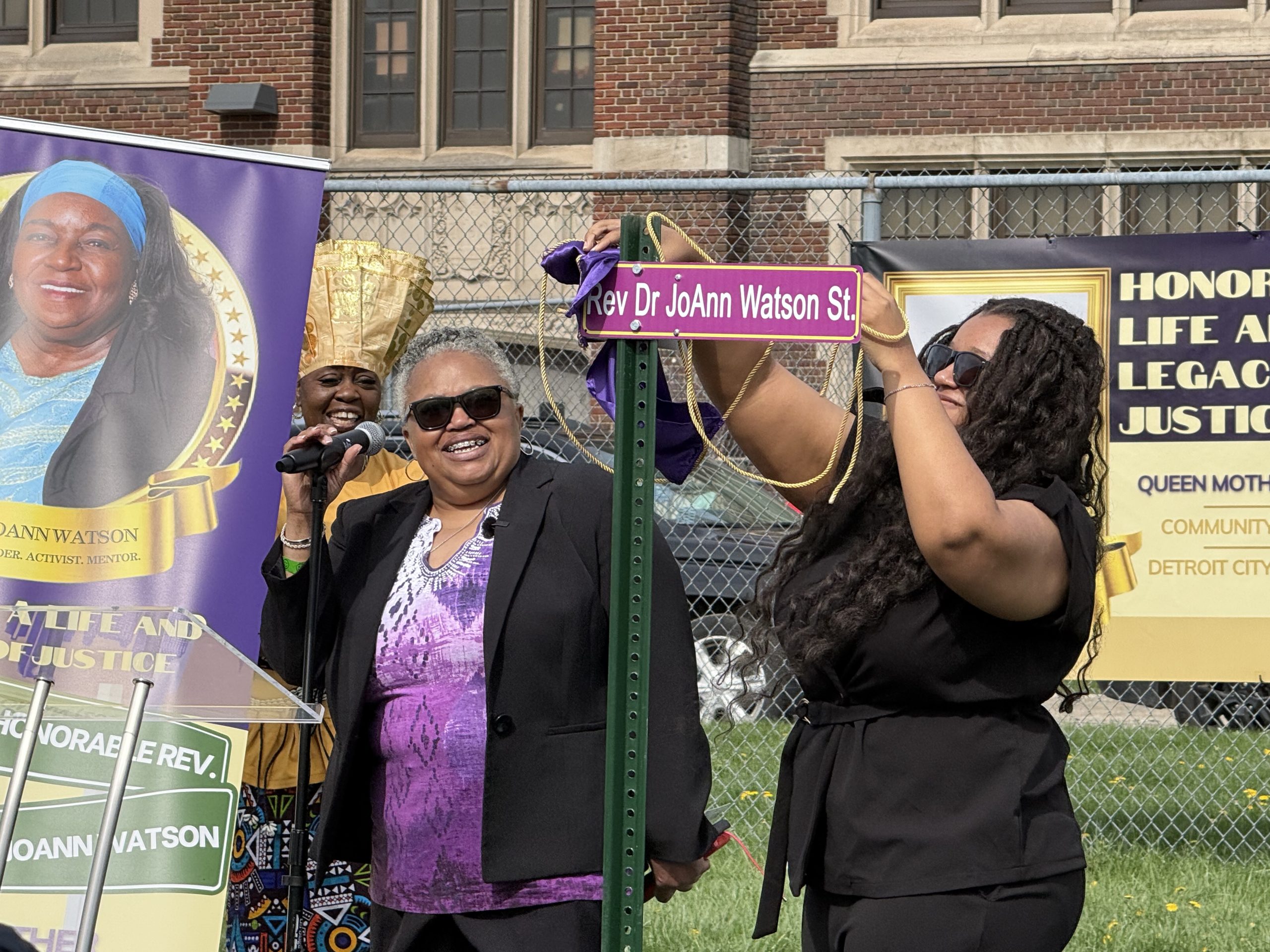
Detroit formally honored JoAnn Watson on April 17, 2026, with a street sign ceremony at Central High School near Tuxedo and Linwood, memorializing a woman whose influence reached from Detroit City Council chambers to the United Nations.
Mayor Mary Sheffield co-sponsored the secondary street sign while she served as president of the Detroit City Council, and she stood before the crowd Friday to describe what Watson’s choices meant to her own career. Sheffield made history in 2013 as the youngest City Council member elected in Detroit’s history, winning her seat at 26. That path opened, Sheffield said, because Watson stepped aside from the same district race that year.
“The entire trajectory of my life has changed because of that one run in 2013,” Sheffield said. “I know that I wouldn’t be here if it had not been her sacrificing her service.”
That single decision by Watson rippled forward more than a decade. Sheffield went on to become Detroit’s first woman mayor. The street sign she helped bring to life now sits on the grounds of the same Central High School where dozens gathered Friday, a couple of days before what would have been Watson’s 75th birthday.
Watson died in July 2023 at 72.
A Career That Crossed Decades and Continents
Watson’s record in public life was long and specific. She served on the Detroit City Council from 2003 to 2013, spending a decade as a fierce advocate for water rights and human rights. Before that, she became the first woman director of the Detroit NAACP. She worked as a public liaison for the late former Congressman John Conyers Jr. and pastored at West Side Community Church. She hosted “Wake Up Detroit!”, a radio and television program that speakers at Friday’s ceremony described repeatedly as a force in the city’s civic life.
Maxine Willis, a colleague of Watson’s at WHPR FM, the city’s Black-owned and operated radio and television network, put it plainly. “Her voice may be silent but her impact will continue to echo,” Willis said.
Watson also held positions with the Black Legacy Coalition, the Detroit Council of Elders, and the Unity Urban Ministerial School. Sheffield appointed her to lead the voter-approved Detroit Reparations Task Force, a role that reflected Watson’s lifelong push for reparations for descendants of enslaved people, a cause she carried into her final days.
Sheffield: She Was a Fighter
The two-hour ceremony drew people who knew Watson from different chapters of her work. Sheffield threaded together the personal and political in her remarks, calling Watson “bold and unapologetic” and crediting her with modeling what genuine public service looks like. Sheffield said she didn’t serve alongside Watson on the council, but she watched closely.
“No matter how you came to know Rev. Watson, one thing was very clear: She was a fighter for our people,” Sheffield said.
As Bridge Detroit reported from the ceremony, Sheffield also said Watson “reminded us that she was committed to the work” even near the end of her life, a detail that drew audible response from the crowd gathered at Central High School.
Watson’s reach was inter-generational, which showed in who showed up Friday and what they said. Her work at WHPR FM brought her into living rooms across the west side for years. Her council tenure put her in the room for some of Detroit’s hardest budget and infrastructure fights. Her reparations advocacy put her in coalitions that stretched well beyond city limits.
What the Sign Represents
Secondary street signs in Detroit aren’t handed out routinely. The City Council’s honorary naming process requires sponsorship from council members and approval through committee. Sheffield’s co-sponsorship while council president gave the effort institutional weight.
The location matters. Central High School on Tuxedo near Linwood sits in a part of northwest Detroit that Watson knew well from her radio work and her community organizing. The neighborhood has seen disinvestment and reinvestment cycle through for decades. A sign there carrying Watson’s name places her legacy in a specific geography, not an abstract one.
Detroit’s Reparations Task Force, which Watson helped lead before her death, continues its work under city oversight. The task force was created through a voter-approved measure, and its recommendations will eventually go back to the council and the mayor’s office for action. Watson spent decades arguing that Detroit’s Black residents deserved direct acknowledgment of historical harm. The sign on Tuxedo and Linwood is one acknowledgment. The task force’s final report will be another.