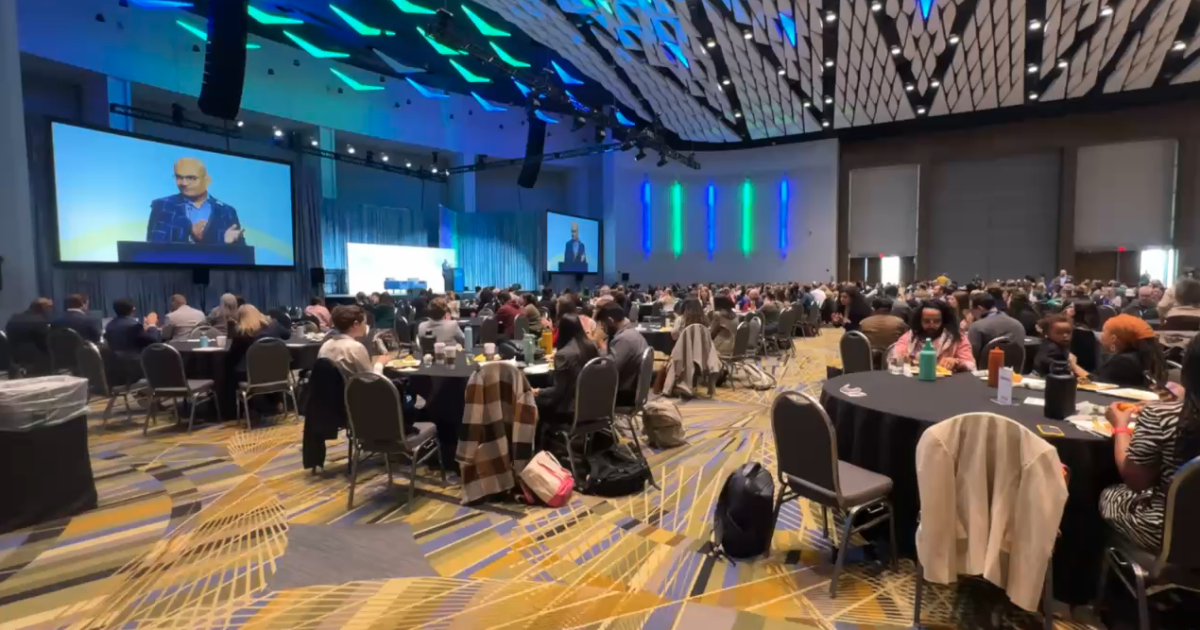
The fourth annual MI Healthy Climate Conference drew about 700 attendees to Huntington Place in Detroit on Tuesday, centering on green funding access and workforce development as the state pushes toward a cleaner energy future.
Gov. Gretchen Whitmer addressed the crowd by video, announcing a $1.8 million grant competition for industrial decarbonization. That money is aimed at pulling Michigan manufacturers into lower-emissions operations, and it signals the kind of state-level investment advocates have been pushing for across multiple budget cycles.
The conference, held on the Detroit Riverfront at the edge of the Great Lakes system, brought together fellows, nonprofit directors, municipal officials, and researchers. The setting wasn’t incidental. Jeff Johnston with the Michigan Department of Environment, Great Lakes, and Energy made that clear.
“We’re right here on the beautiful Detroit Riverfront, part of the Great Lakes system,” Johnston said. “We’ve got 3,200 miles of coastline in Michigan on the Great Lakes, 11,000 rivers. I’ve got all these amazing numbers that talk about just how important our relationship with the natural world is.”
Johnston framed the conference’s purpose in direct terms. “To engage in climate action, to mitigate the problems of greenhouse gases and fossil fuels that endanger that environment, endanger our livelihoods and our lives is just some of the most important work we can be doing,” he said.
Transit as climate policy
One of the sharper arguments made at the conference came from Transportation Riders United, a Detroit-based advocacy group pushing for expanded public transit across the state. Michael Goldman Brown Jr., an MI Healthy Climate fellow placed at the organization, said the transit and climate conversations can’t stay separate.
“I’m sited at Transportation Riders United right here in Detroit, and I’m working on expanding and advocating for better transit here in Detroit but also the entire state of Michigan,” Goldman Brown said.
Megan Ownens, director of Transportation Riders United, put a number to it. “About a third of pollution comes from transportation, from cars and trucks and planes and everybody getting where they need to go,” Ownens said. “So that’s why we at Transportation Riders United are part of this. We want to make sure people have options other than their car.”
Detroit doesn’t have a lot of margin here. The city has historically thin transit coverage compared to peer cities, and residents without cars take the longest routes to the shortest jobs. Connecting transit expansion to carbon reduction gives advocates a second argument when the first one stalls.
Detroit residents at the center
Shawna Forbes Henry, executive director of Community 2 Me Network, came to the conference with a specific focus on Detroit neighborhoods that face the heaviest environmental burdens.
“Detroit is an area that is heavily impacted by various climate changes and emergencies,” Henry said, according to WXYZ (7 Action News). “We are here to ensure that our residents have the training that they need, have the economic resources that they need, and have the ability to feed that pipeline for employment.”
That framing matters. Climate conferences can drift toward abstraction fast. Henry’s argument is that environmental investment has to land as job training and economic stability for Detroit residents, not just cleaner air metrics that get reported in Lansing.
Fellows program expanding reach
More than two dozen fellows worked the conference floor Tuesday, each placed with a nonprofit, municipality, or green-focused business across Michigan. The program is spreading climate work beyond the I-75 corridor in ways the state’s policy apparatus can’t do alone.
Jenny Kalejs, an MI Healthy Climate fellow working in the Upper Peninsula, described a youth conservation magazine she helped develop. “We do land stewardship, protection of ecologically sensitive lands, organizing community partners, so we can better collaborate,” Kalejs said.
The Michigan Department of Environment, Great Lakes, and Energy runs the program, which places fellows statewide in roles that range from transit advocacy in Detroit to land conservation in the U.P. It’s a structure that acknowledges what Lansing-only policy often misses: the problems in Brightmoor don’t look like the problems in Marquette.
Whitmer’s $1.8 million decarbonization competition now opens for applicants. The U.S. Department of Energy has pushed similar industrial decarbonization frameworks nationally, and Michigan is positioning itself to capture federal and state dollars simultaneously as manufacturing transitions accelerate. Johnston’s office has not set a public deadline for applications as of Tuesday’s conference.