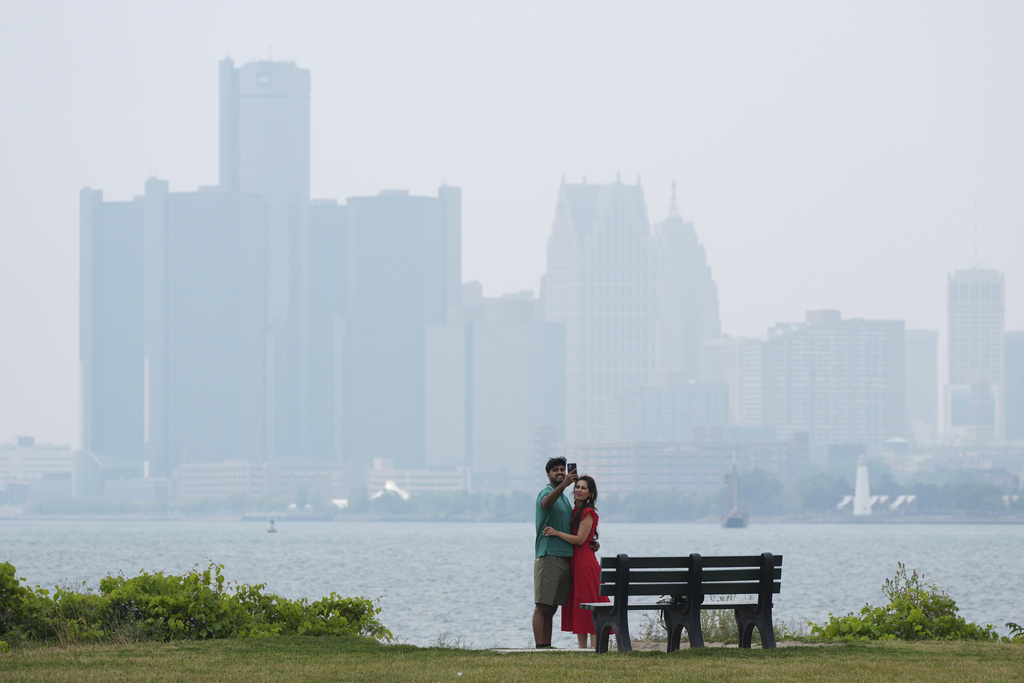
Michigan is lowering the threshold for air quality alerts this spring, a shift that will put more warnings in residents’ phones and inboxes before wildfire smoke reaches dangerous levels.
The Michigan Department of Environment, Great Lakes, Energy will now issue alerts whenever fine particulate matter or ozone climbs into the “unhealthy for sensitive groups” range on the federal Air Quality Index. That’s the orange range. Previously, the state only issued alerts when conditions hit the red, or “unhealthy,” range, and issued advisories for orange. The change collapses that two-tier system into one, earlier trigger.
For Detroiters, that means warnings arrive sooner.
The update comes after Canadian wildfires sent smoke choking through the region in both 2023 and 2025, pushing air quality into ranges that health officials said posed real risks to children, older adults, and anyone with asthma or heart disease. The state is not waiting for another summer of that to pass before acting.
What the new alert means for you
Jim Haywood, senior meteorologist with EGLE, said the agency’s forecasting models are getting better, but he doesn’t trust smoke predictions that go beyond a 24-to-48-hour window. Smoke from wildfires hundreds of miles away can travel in ways that are hard to model. Whether it stays high in the atmosphere or drops to ground level depends on conditions that shift quickly.
“It can be difficult to predict where smoke traveling over long distances will go, and if it will affect air quality or remain well above ground-level,” Haywood said.
That uncertainty is exactly why the earlier alert threshold matters. If state officials can’t reliably forecast smoke more than two days out, residents need the system catching problems at orange rather than waiting for red.
Haywood recommends the EPA’s AirNow webpage for a 48-hour air quality forecast. The EPA’s EnviroFlash system sends local alerts directly to subscribers. For hyperlocal readings, JustAir and PurpleAir run private monitoring networks that track air quality block by block. FireSmoke Canada publishes a multiday ground-level smoke forecast map covering most of the U.S. and Canada.
What this season looks like
The state isn’t updating its alert system in a quiet year. Forecasters are watching conditions on two fronts.
In Canada, Brian Wiens, managing director of the research partnership Canada Wildfire, told Bridge Detroit that he expects fewer fires north of the border than last year. Drought or dry conditions persist in Saskatchewan, Manitoba, Ontario, and Quebec, though recent storms have helped some areas. The bigger wild card is a possible El Niño pattern. If it sets in, it could bring heat to Alberta and British Columbia and raise fire risk significantly in late summer.
That’s the scenario Michigan officials will be watching most closely. Fires in western Canada have historically been the primary source of the smoke events that hit Detroit hardest.
South of the border, the picture is more immediately alarming. The National Interagency Fire Center’s April outlook forecasts significant fire potential across much of the South and Southwest through April and May, with large portions of the West facing increased wildfire risk in June and July. Every state except Michigan and North Dakota is experiencing some level of drought or abnormal dryness.
Michigan won’t escape the consequences of fire seasons that play out a thousand miles away.
Who’s most at risk
The orange AQI range, now the new alert threshold, is specifically defined around “sensitive groups.” That includes children, people over 65, and anyone with respiratory or cardiovascular conditions. In Detroit, where asthma rates in neighborhoods like Delray and the 48217 zip code run well above the national average due to decades of industrial pollution, an earlier warning system isn’t a minor bureaucratic adjustment. It’s a public health tool.
EGLE hasn’t announced a specific public outreach campaign tied to the new threshold, and it’s not clear how widely residents know the agency’s alerts have changed. The EnviroFlash signup page exists, but signing up requires residents to find it.
The National Interagency Fire Center updates its monthly fire outlook through the summer. Michigan’s next test of the new alert system will come whenever the first smoke event rolls in, likely before July.