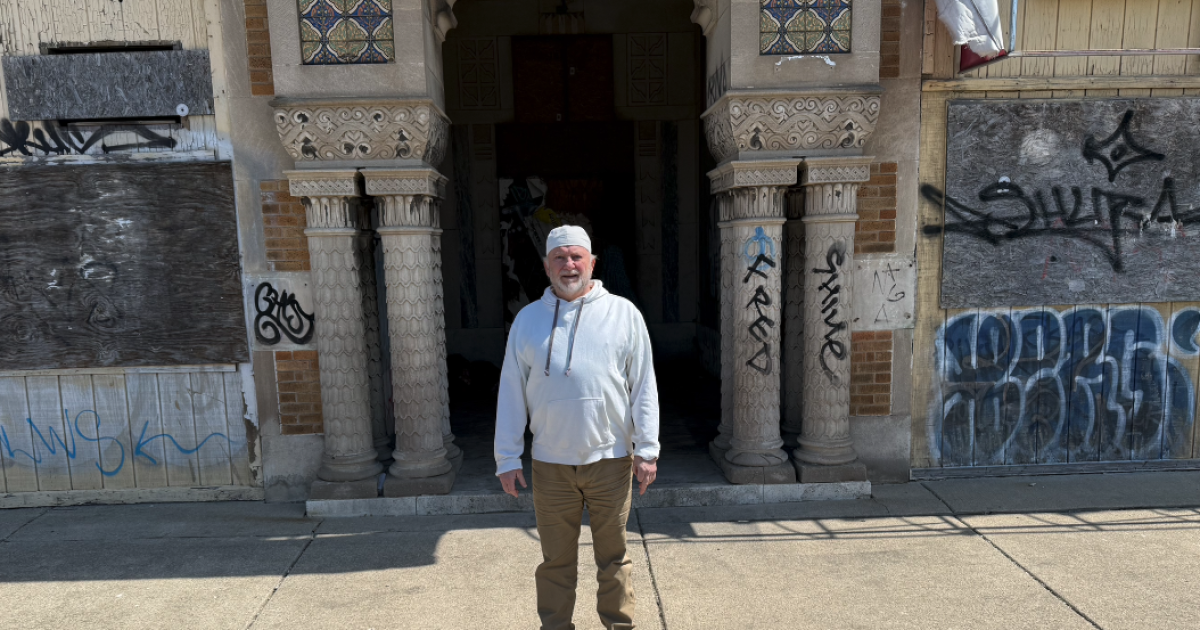
Tim Burke is running out of time. The Highland Towers Apartments on Woodward Avenue in Highland Park could face demolition as early as the end of this month, and Burke is already inside pulling tile off the walls.
The building has sat vacant for nearly two decades, abandoned and later burned, its ornate facade slowly coming apart from neglect. Burke, a Detroit artist known for turning salvaged architectural pieces into public art, believes the colorful tiles lining the exterior are Flint Faience, a decorative ceramic produced in Flint dating to the late 1920s. He’s planning to turn what he recovers into benches, tables, and other public installations so the craftsmanship doesn’t just end up in a landfill.
“I don’t want to lose history,” Burke told WXYZ (7 Action News). “We don’t make buildings like this anymore.”
Permission wasn’t easy to get
Getting access to the site took months of phone calls and dead ends. Burke said he spoke directly with the mayor, who directed him to the Wayne County Land Bank. He didn’t hear back. A friend eventually reached the office of Sen. Stephanie Chang, and Chang’s office helped Burke get the green light from the county.
“I was wracking my brain, how can I get permission to do this?” Burke said. “It was like when I gave up hope, it happened.”
The Wayne County Land Bank controls hundreds of vacant and tax-foreclosed properties across the county, including many in Highland Park, where decades of population loss and disinvestment have left large stretches of the city’s housing stock in disrepair. Getting formal permission to enter a condemned structure for salvage isn’t a simple ask, and Burke’s path through the bureaucracy reflects how hard it can be to preserve anything before the wrecking crews show up.
What he’s trying to save
Burke is focused on two specific elements of the Highland Towers facade. The Flint Faience tiles carry what he describes as a Moroccan style, a bold decorative choice that set the building apart when it was constructed nearly a century ago. He’s also targeting the red trim pieces above the tile line and the pillars that hold the archways.
Burke has driven past the building for decades. He watched it decline from occupied apartments to an abandoned shell to a fire-damaged ruin, and he says the architectural detail held up even as everything else fell apart.
“That beautiful Moroccan style,” he said. “I get charged when I see this. I know what went into this.”
Flint Faience tile was produced by the Flint Faience and Tile Company, which operated in Flint during the early 20th century and became known for its vivid glazed ceramics. Examples of its work appear in buildings across Michigan and the Midwest, and intact installations are increasingly rare as older structures come down.
Funding it himself
Burke is covering most of the salvage costs out of his own pocket. He has a fundraiser running online to offset expenses, though he didn’t put a dollar figure on what the project will cost in total.
The effort fits a pattern he’s built over the years, working to pull pieces of Detroit’s built history out of demolition sites before they’re gone and giving them a second life in public spaces where people can actually see them. It’s unglamorous work. It requires permits, connections, physical labor, and money, and it almost always happens under deadline pressure because the demolition schedule doesn’t wait.
Highland Towers isn’t alone. Across Highland Park and Detroit, buildings from the early 20th century are coming down at a pace that outstrips the capacity of any single preservationist to respond. The city of Highland Park has faced severe fiscal stress for years, and the Michigan State Housing Development Authority has been involved in various stabilization and demolition programs in the area.
“It kills me to see buildings being torn down, this attention to detail and style,” Burke said. “I just love Detroit. It’s my city.”
With demolition potentially starting before May, Burke is working through the building as fast as he can, pulling what he can carry, trying to keep at least part of a 1920s Woodward Avenue facade from disappearing entirely into a debris pile.